
When Systems Fail

Short version. A PHP runtime flaw and a breach through an AI tool's integrations, traced layer by layer to the party that holds each fix. The shared shape: the failure lived one layer below where a reader naturally looks, and every layer names its holder. The boundary — every count carries its vendor source, disclosed as such, and no Orange Tomato article is cited as a source.

On the evening of October 21, 2026, the Dutch government took its own front door offline. DigiD, the login system millions of people use to reach public services, went dark around half past eight. MijnOverheid, the personal government inbox, had gone two hours earlier. By the next morning the tax authority's sites were down too. In Finland, the state IT provider pulled government public-network services as a precaution, expecting to restore them by late afternoon. France told its local prefecture sites to wait for a fix. More than thirty government services in Britain went dark. In Japan, a major bank suspended some online services and the Finance Ministry halted parts of its website. Wikipedia's project systems suspended service. The Internet Archive went briefly offline.
No attacker had taken these sites down. Their operators had. Somewhere underneath all of them, in a layer none of their visitors ever see, two critical holes had been found in PHP itself. That is the programming language runtime that assembles roughly seven in ten websites on the internet. The people responsible for those sites had decided that going dark for a night was safer than staying up on a vulnerability they could not patch themselves. That decision, repeated across countries in a matter of hours, is the shape this piece is about. When the failure sits a layer below your hands, the only question that matters is who holds the fix.
Most of the sites came back within days. The Dutch login systems returned the same night. The tax sites followed in the morning. Japan's Finance Ministry restored its pages in stages and declared full resumption five days later. Wikipedia and the Archive were back within roughly a day. For the French prefecture sites and the British services, no public restoration date was ever published in the sources this research could inspect. The silence is part of the story. Shutdowns are announced. Recoveries often are not. The Dutch liveblogs timed the returns through the night: the login systems back the same evening, the tax sites in the morning. Japan's Finance Ministry posted its own sequence, partial resumption the next day and full resumption five days later, with a press conference in between reporting no damage found. Wikipedia's project systems and the Archive needed roughly a day, and the Wikimedia foundation's later bulletin filled in the phased detail. These are the recoveries the record shows. The French prefectures, the British services, the Finnish networks: taken offline in public, brought back in private, on schedules nobody published. A precautionary shutdown is a decision an operator can take alone. A restoration is a verification, and verifications rarely get press releases.
The holes were CVE-2026-109618 and CVE-2026-109619, collectively called PHP2Shell. Both were rated 9.2 out of 10 on the standard severity scale. Both let an attacker with no account and no password run their own code on a web server running a vulnerable PHP. Both lived not in WordPress, not in a plugin, not in any theme or storefront code, but in PHP's own memory handling, the engine room underneath every application built on the language.
The first flaw corrupts memory when PHP runs out of it at exactly the wrong moment, leaving half-built internal structures behind that the engine later treats as valid. The second lets one web request leave stale internal state behind for a later request on the same worker process to pick up and reuse. Both were demonstrated as full remote code execution on the most common Apache setup, before any application code even ran. That last detail is the one that matters for everything that follows. The flaw fires before your code loads, so nothing your code does can stop it.
To feel the weight of that, picture the stack as floors in a building. Your site, the words, the checkout, the login form, lives on an upper floor. PHP lives on the floor below, the one with the wiring. Updating a plugin or switching a theme is rearranging furniture upstairs. PHP2Shell was a fault in the wiring, and rearranging the furniture changes nothing about it. The fix had to come from whoever controls the wiring: the hosting provider, the server owner, the people who ship the container image. Almost never the person who built the site. The PHP project's own advisory said so in plain terms. Updating an application such as WordPress or Laravel does not update the PHP runtime beneath it. The fix arrives through the server package, the host, or the container image.
The patched releases landed on October 21: PHP 8.5.12, 8.4.27, 8.3.36, and 8.2.35. WordPress itself released no software update in response, because there was no WordPress-layer fix to release. A security firm that protects WordPress sites spelled out the consequence for its users the same day. Automatic updates would not apply this fix. If your site runs on managed hosting, you were waiting on your host. If it runs on your own server, the job was yours. Many site owners learned that week, some for the first time, which of those two people they were.
Who holds the binary
That question, who actually controls the PHP binary in your setup, turns out to be the whole practical story. The answer changes with every kind of hosting, and each answer names a different holder.
On managed shared hosting, the host controls PHP. The site owner can pick a version per domain from whatever the host has installed, through tools like cPanel's MultiPHP Manager or Plesk's per-plan PHP settings, but cannot patch the runtime. The host installs the fix or nobody does. On hosts using CloudLinux, there are two stacks: the panel-managed PHP and a hardened vendor-patched selector that can cover older branches the panel no longer ships. Either way, the tenant's only move is to ask, to check, and if necessary to leave.
On a VPS or a dedicated server you administer yourself, the job is yours in full. Update the package or build from source, then restart every PHP worker. The restart matters more than people expect. A running worker keeps serving the old code until it is recycled, so a patched binary with un-restarted workers is a fix that has not taken effect. Several of the post-disclosure guides put the restart in bold. It earned the emphasis.
In containers, the image maintainer holds the fix, and a running container is immutable until it is rebuilt. The official PHP images picked up the patched tags after the php.net release. The official WordPress images reached Docker Hub later that same day, roughly four hours after the language release. Anyone running WordPress in Docker who clicked update in the dashboard that afternoon updated the application only. The runtime underneath changed when somebody rebuilt the image. One early publisher, Chainguard, had fixed images out hours before the coordinated release. That drew an angry response about supply-chain disclosure, and it also demonstrated how the container layer can move faster than the announcement it is supposed to wait for.
Through Linux distributions, the vendor carries the fix back into older versions, and the version number will mislead you if you let it. Ubuntu, Debian, and Red Hat backported the patches into their packaged PHP builds, which keep the old version string while the package revision carries the fix. Checking the version flag tells you nothing. The changelog tells you everything. This matters because the official fix only covers supported branches. PHP 8.1 reached end of life at the end of 2025, and versions back to 5.4 have no upstream fix at all. For those, the PHP security team published minimal source backports for 7.4, 8.0, and 8.1, enough to build from source or to tide vendors over, and the distributions filled the rest unevenly. Ubuntu's extended support covers branches back to PHP 5.5 on old releases. Debian fixed its current branches and left older ones to paid extended support. Red Hat's stream table was still showing one PHP 8.4 stream as affected in early November. Community backports exist for long-dead versions and carry no official standing whatsoever.
Managed platforms sit at the far end of this spectrum. WordPress.com stated on the day of disclosure that its sites, along with its VIP, cloud, and Pressable fleets, were already protected at the infrastructure level, with no customer action needed. That is the bargain of managed hosting stated honestly. You cannot fix the runtime yourself, and in exchange, somebody else fixes it for you. The bargain only works if you know which side of it you are on. For the site owner who has never asked, the checks are concrete. On shared hosting, open the panel and see which PHP versions the host offers; if the newest patched branch is missing, the question goes to support, in writing. On your own server, update the package, restart every worker, then confirm the running version rather than assuming the install took. In containers, rebuild the image and confirm the new tag is what actually deployed. On a distribution package, read the changelog instead of the version flag. Each of these takes minutes. Each answers the only question that matters: who holds this binary, and have they moved.
From thousands to millions
The disclosure itself nearly went wrong before it started. Technical details of the flaws leaked online before the coordinated release date. Proof-of-concept exploits circulated before the patches went live, though the PHP security team said none of them worked. The project shipped a day early, on October 21 instead of the 22nd. By then, attack traffic was already underway.
Cloudflare had deployed its firewall protections about nine hours before the public announcement. Its customers on free and paid plans alike were covered by default from the early hours of the 21st. Amazon's threat intelligence had spotted exploitation attempts four days before patches existed, on October 17. Multiple security firms reported pre-disclosure probing. All of it, at that point, unsuccessful. One threat-intel team later summarized the pre-patch period precisely: scanning, fingerprinting, and non-working exploits, with no known compromises.
After disclosure the numbers moved the way they always move. Cloudflare's figures, reported by its chief executive the next day, traced the arc. Thousands of attempts before disclosure, tens of thousands within forty-five minutes of it, hundreds of thousands within two hours, and millions by the following day. Those are Cloudflare's counts from its own network, not an independent census of the internet. As a measure of pace, though, they describe what every administrator already knows. A critical runtime flaw does not get exploited gradually. The window between a patch being available and mass exploitation is measured in hours. The patching fleet moves in days and weeks.
The firewall vendors held the line in the meantime, and they were unusually clear about what their line was worth. Cloudflare built something new for the occasion: detection that combines signals from the request and the response inside the same transaction. A blocked attack is confirmed by what the server almost sent back rather than guessed from what came in. These were the first managed detections shipped with that capability. AWS added rules to its managed rule group in two steps, coverage for the second flaw on October 22 and extended coverage for the first on October 23, switched on by default, with guidance for the end-of-life versions added the following week. Both vendors put the same sentence in the same prominent position. "Patching is the only complete fix, and you should upgrade PHP as your first priority." A firewall rule buys time. It does not close the hole.
The month after
As of the first reporting, an important line held. No confirmed successful compromise had been publicly documented. Attack traffic is not compromise, and every careful outlet kept the two apart. That line has since moved, and the way it moved is instructive.
The first substantial confirmation came on October 24, from honeypots run by a Perplexity detection lead, Adel Karimi. The traps recorded genuine remote code execution against an Apache setup running PHP 8.4.26, including a memory dump of several hundred kilobytes pulled out through the flaw. An independent researcher with a strong record on exactly this kind of evidence called it the highest-quality in-the-wild confirmation seen to that point. Karimi attached the bound himself, and it travels with the finding wherever the finding goes. The demonstration ran on an intentionally favorable single-worker configuration. It says nothing about how reliable the exploit is on other setups, builds, or applications. A proof that the chain works end to end is not a measure of how often it works. Both halves of that sentence belong in any retelling.
Three days after disclosure, both flaws entered the US government's catalog of known exploited vulnerabilities, which sets a binding patch deadline for federal civilian agencies. A vendor report at the end of the month described a chained campaign pairing PHP2Shell with a separate Linux kernel privilege flaw to take over firewall appliances. Twenty-five servers across four countries, with three in a US-government-affiliated environment, according to the vendor. The firewall maker's own research unit verified the attacker's tooling and results, according to the same report. The recovered artifacts pointed to an operation that began with exploit development in a lab and ended with access to a government organization's internal directory, via credential extraction after the appliances fell. The report also noted signs of AI-assisted tooling in the attack infrastructure. All of this comes from a single security vendor and should be read as its findings, not as an established census. But it points at the shape of what runtime flaws enable once weaponized. The flaw gets you in, and something else gets you root.
And yet, as of early November, there were still no reports of mass breaches. A Kaspersky review two weeks after the patches noted the retraction of one claimed hit on a European government agency, and put the exposure in stark numbers. Of 46 million scannable servers running a vulnerable PHP, 29 million were still unpatched. The scanners keep scanning. The fleet keeps moving slowly. Late in the month, the WordPress-focused security press was still reporting attempts rather than successes: no WordPress compromise known to its analysts, and request logs showing probes, not takeovers. The gap between those two facts is the risk, stated without drama.
One more disclosure belongs in this section, because it complicates any all-clear. On October 23, the PHP project published an advisory for a third flaw, CVE-2026-115560, which affects fully patched releases including the newest one. It allows the same kind of attack, but only under an unusual combination of configuration and application code. Session handling changed at runtime while upload-progress tracking stays enabled. PHP's team judged that combination exotic enough to fix on the regular release schedule rather than by emergency, and no fix release had appeared as of mid-November. Until one ships, the mitigation is a single configuration line. Turn the upload-progress setting off. AWS confirmed its existing firewall rule already covers that vector. The lesson is not that patching failed. A runtime is never finished being patched. The people who hold the binary hold an ongoing job, not a one-time errand.
There is a coda to the discovery story worth keeping. The flaws surfaced through a new round of security attention on PHP itself. The pieces: a first external audit in years, funded through a European technology agency and carried out by the firm Quarkslab, plus AI-assisted tooling on several sides of the coordinated disclosure. A PHP core developer had already glimpsed the first flaw's shape in 2024 while fixing an audit finding, theorizing an exploit nobody could yet build. Two years later, the tooling caught up with the theory. A researcher at a London university warned that the same tooling now accelerates the attack side too. That warning travels as one researcher's view, not as a documented finding. It earns its place here because it names the next window. Discovery keeps getting faster. The patching fleet does not.
The breach that travelled through an AI tool
A different failure, months earlier, shows the same question from the other side of the stack. In April 2026, attackers reached inside Vercel, the cloud platform behind a large share of the modern web, and the way in did not touch a model at all.
Vercel's own incident bulletin, closed on October 16, traces the path step by step. The entry point was Context.ai, a small third-party AI tool used by a Vercel employee. Compromising that tool gave the attackers the employee's Google Workspace account. The Google account gave them the employee's Vercel account. The Vercel account gave them a Vercel environment, and from there they moved through internal systems, enumerating and decrypting stored environment variables. The variables they reached were the ones customers had not marked sensitive: API keys, tokens, database credentials, signing keys, the ordinary secrets of running software. Vercel's bulletin distinguishes this carefully from two things it was not. The company's published packages were independently confirmed uncompromised, with no evidence of tampering. A separate small set of customer account compromises found during the investigation did not appear to originate from Vercel systems at all. The company brought in outside incident responders, notified law enforcement, and engaged the AI vendor directly to scope its compromise.
Read that path again and notice what is missing from it. No model was hacked. No prompt injection appears in the account. The AI tool in the story is a doorway, not a culprit. One integration among several, each of which trusted the identity that arrived from the previous one. The failure is a property of the chain, and the fix belongs to whoever controls each link. Those are the limits on what the third-party tool can reach, the Workspace account's protections, the permissions of the Vercel identity, and the marking of which secrets even a legitimate reader may see. Vercel's recommendations read exactly that way. Require phishing-resistant login. Treat every unmarked variable as exposed and rotate it before anything else, since deleting a project does not remove the threat to copied secrets. Mark secrets sensitive so they cannot be read back. Review activity logs and recent deployments for anything unexpected. Set deployment protection to standard at a minimum. Each item hands a specific job to a specific holder.
What the breach numbers actually say
The industry's most quoted measurement of this kind of failure arrives with a denominator most quotations drop. IBM's 2026 Cost of a Data Breach study reports that 21 percent of the organizations in its sample experienced a security incident involving an AI model or application, up from 13 percent in its previous round. The sample is 602 organizations that had already suffered breaches, surveyed about incidents from March 2025 through February 2026, and drawn from seventeen industries across sixteen countries. That means the 21 percent describes organizations already in a breach study. It is not the share of all companies that suffered an AI breach. Quoting it without the denominator turns a finding into a scare figure. The study was conducted by the Ponemon Institute and sponsored and analyzed by IBM. The full questionnaire, the wording, the sampling, the weighting, sits behind a contact form, so none of it can be inspected. The figure is best read as what respondents in IBM's breach sample reported. Nothing more specific is available, and nothing more specific should be claimed.
The same discipline applies to the study's most-shared details. IBM's summary says two reported issues each appeared in 27 percent of the AI-related breaches: cloud misconfigurations affecting AI workloads, and compromises of connected applications, APIs, or plugins. Those two numbers must not be added together. The public summary does not say whether the categories overlap or how respondents selected them. They do not establish that any reported condition caused any breach. They identify what respondents reported seeing around their incidents. The study also says 92 percent of organizations reporting AI-related breaches lacked what it calls proper AI access controls, naming role-based access and multi-factor authentication as examples. The word proper is IBM's, and the summary never defines how it was assessed. It does not show that any single control would have prevented any particular breach.
None of this dismisses the finding. The same summary lists AI-specific causes too: poisoned data, prompt injection, model inversion. The honest reading is the one the bulletin and the study share. The system around the model belongs in the security picture. Getting the numbers right does not weaken that point. It is what makes the point worth acting on, because a holder who is told the truth about the evidence will still be holding the job after the headline moves on.
The pattern: every layer names its holder
Put the two stories side by side and the shared shape appears. In each, the failure lived one layer below where the reader naturally looks. The site owner looks at the application. The fix lived in the runtime, held by the host, the image maintainer, the distribution vendor. The AI adopter looks at the model. The fix lived in the integration, held by whoever granted the tool its identity and its permissions. In each, a stopgap existed that bought time without closing anything. Firewall rules filter the traffic while the binary stays vulnerable. Access hygiene narrows what a compromised identity can reach while the trust chain stays long. In each, the pace of exploitation set the terms: millions of attempts within hours on one side, an attacker moving from a third-party tool to production secrets before anyone noticed on the other.
The security community has a name for the second half of this. An AI system granted the ability to call functions and reach other systems, through extensions, plugins, or connectors, can do damage whenever its outputs go wrong, for whatever reason. A bad prompt. A weak model. An injected instruction from a compromised peer, or a hallucination from a perfectly benign one. The defense, in the OWASP guidance on excessive agency and in NIST's API-protection guidelines (current through the March 2026 update, which added risk and control catalogs), is structural rather than verbal. An agent given document access through an extension that can also rewrite and delete was granted too much function. A reader identity carrying write permissions it never needs was granted too much permission. A system left to chain its own invocations without checkpoints was granted too much autonomy. The guidance names all three excesses because every incident travels through at least one of them, and the fix in each case is the same. Check authorization in the downstream system, where the action happens. A prompt telling the model to use only approved data enforces nothing by itself. These are general principles, not explanations of any particular breach. Their value is that they name the holder in advance. The person who configures the connector decides what a compromised agent can touch, long before anything is compromised.
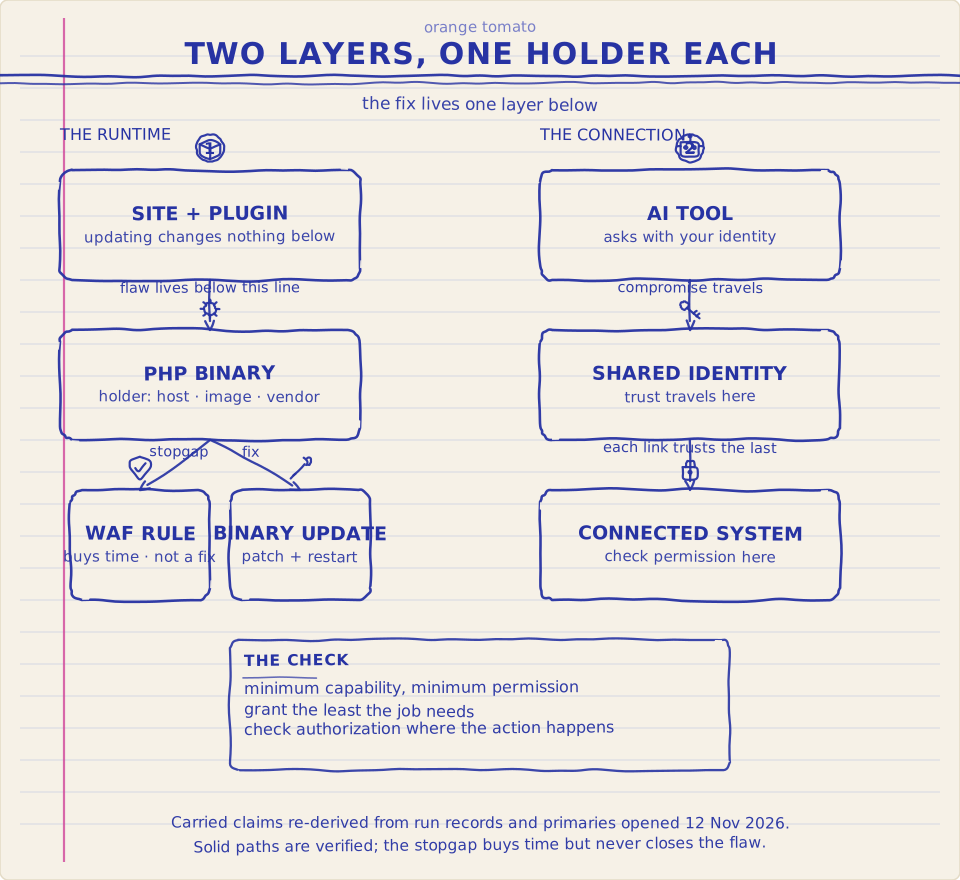
Diagram: two layers, one holder each — and the check that names the holder in advance.

What you can inspect
The reader's version of all of this fits on an index card. Find out who controls your PHP binary: your host, your image maintainer, your distribution, or you. Confirm the patched version is installed and every worker restarted. Check whether your branches are still supported, and if they are not, find out whose backport you are relying on. Treat firewall coverage as a window rather than a wall, and ask when it expires. For every AI tool connected to your work, ask which identity it uses and what that identity can reach. Ask which files, APIs, and actions sit behind its connectors. Ask whether the connected system checks permission itself or trusts the model to behave. Ask whether you can see what the integration touched, and whether you can revoke it. Mark your secrets so they cannot be read back. Rotate what was readable. None of these steps requires trusting a headline number. Each one names a holder, and in several cases the holder is you.
Sources and method
Every load-bearing claim above traces to a primary source reopened at a pinned date in November 2026: the PHP advisory and release records, the PHP Foundation's October 21 post, the Cloudflare and AWS engineering posts with their dated update banners, the CISA catalog entries, the Vercel incident bulletin, and IBM's public study materials. It also draws on the OWASP and NIST guidance pages, and on contemporaneous reporting from BleepingComputer, Kaspersky, and national outlets for the shutdown timeline. Figures travel with their bounds. Cloudflare's counts are Cloudflare-sourced. IBM's shares carry their denominator, sponsorship, and gating. The Dream campaign is a vendor report with vendor-claimed independent verification. The honeypot confirmation carries its single-worker bound. No Orange Tomato article is cited as a source. Claim-level provenance lives in the run's evidence ledger. This draft's evidence review was performed as a distinct second pass by the drafting agent and is not independent.
Companion notebook (scrollable, 10 pages): When Systems Fail — the notebook.
What changes the judgment
Several threads in this piece are dated observations, not settled facts. The third PHP flaw had no fix release as of mid-November. Its arrival on the regular schedule would close the open item. Restoration dates for the French, British, and Finnish shutdowns were never published in sources this research could inspect. Their confirmation would complete the timeline. Any independently confirmed compromise beyond the honeypot evidence and the single-vendor campaign report would change the breach picture. None had appeared as of early November. IBM's full methodology remains gated. An inspectable questionnaire would let the 21 percent be read as more than a reported share. Each of these is checkable, and each is dated at inspection. A month from now, some will have moved.